Bande Originale CFP | Cannes
Bande Originale - Identité sonore | CFP French Congress of Psychiatry
This project involved the composition and public presentation of the original soundtrack for the 2025 Congrès Français de Psychiatrie, presented in the Debussy Hall at the Palais des Festivals in Cannes. Conceived as a central “mother piece,” CFP – Bande Originale links the congress to the concept of the Agora and musically traces the development of the psyche through stages of birth, maturation, crisis, and healing, combining narrated excerpts with a full performance by a quintet from the Cannes Conservatory. Beyond the concert itself, the project also included the creation of multiple adaptations of the music for different contexts and formats, including social media, ambient spaces, and video, bringing an intensive creative process to a close with a strong sense of artistic and conceptual completion.
Composers André Aires Augusto& João Santos(TheGoldenAura)
Production: CFP 2025
Project direction and conception:
João Santos, Luc Mallet
Debussy Hall at the Palais des Festivals in Cannes.
Support
With the support of the Congrès Français de Psychiatrie,
Alain Baldocchi from the Conservatoire de Musique et Théâtre de Cannes,
Sébastien Charry and organizing team CARCO.


The quintet
Flûte Traversière (Transverse Flute): Caroline Debonne
Caroline Debonne is a flute professor at the Conservatoire de Cannes. She specializes in classical and contemporary flute repertoire, bringing a light, ethereal quality to the piece. In the composition, the flute often carries melodic lines that evoke fluidity and openness, particularly in sections like "Naissance" (Birth), where it represents emerging interactions and growth.
Clarinette (Clarinet): Laurence Tavares
Laurence Tavares serves as a clarinet professor at the Conservatoire de Cannes. Known for her expertise in chamber music and orchestral performance, she contributes warm, expressive tones that add depth to the ensemble. Her role in the quintet highlights the polyphonic elements, especially in transitional phases symbolizing psychological development.
Violon (Violin): Nadine Miccio
Nadine Miccio is a violin professor at the Conservatoire de Cannes. With a background in string performance and pedagogy, she provides fragile, high-register melodies that symbolize vulnerability, as seen in the "In Utero" section where the violin represents the nascent psyche's hesitancy and lightness.
Violoncelle (Cello): Chloé Triscornia
Chloé Triscornia teaches cello at the Académie Rainier III in Monaco and the Conservatoire de Grasse. Her playing offers a grounding, maternal warmth through lower registers, acting as a "sonic cradle" in the composition. This is evident in dialogues with the violin, metaphorically depicting attachment and protection during early psychic formation.
Piano: Eugénie Goldobine
Eugénie Goldobine is a piano professor at the Conservatoire de Cannes. She anchors the harmonic structure with dynamic contrasts, such as strong accents in "Iatros" (representing inner healing and struggle) and subtle progressions in "Sophia" (symbolizing wisdom and resolution). Her contributions ensure rhythmic energy and polyphonic assertiveness throughout.

Methodology
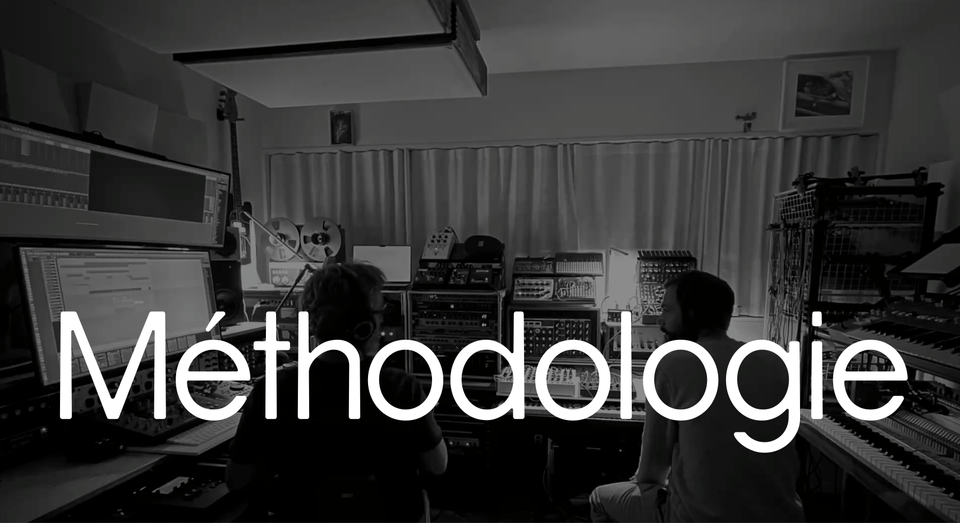
The methodology for creating the CFP's sonic identity involved a collaborative, remote process among composers João Santos (Neuchâtel), André Aires Augusto (Porto), and Luc Mallet (Paris), constrained by geographical distances. It began with intuitive sketches starting from a simple piano melody evolving into a central symphonic "mother piece" notated for coherence and narrative depth, drawing on their film music experience. Adapted to a quintet format for live performance, the approach blended impulsive sound experimentation with structured notation, overcoming challenges like software compatibility and the inability to play orchestral drafts in real time, while ensuring thematic unity across acoustic and electronic variations.
Agora
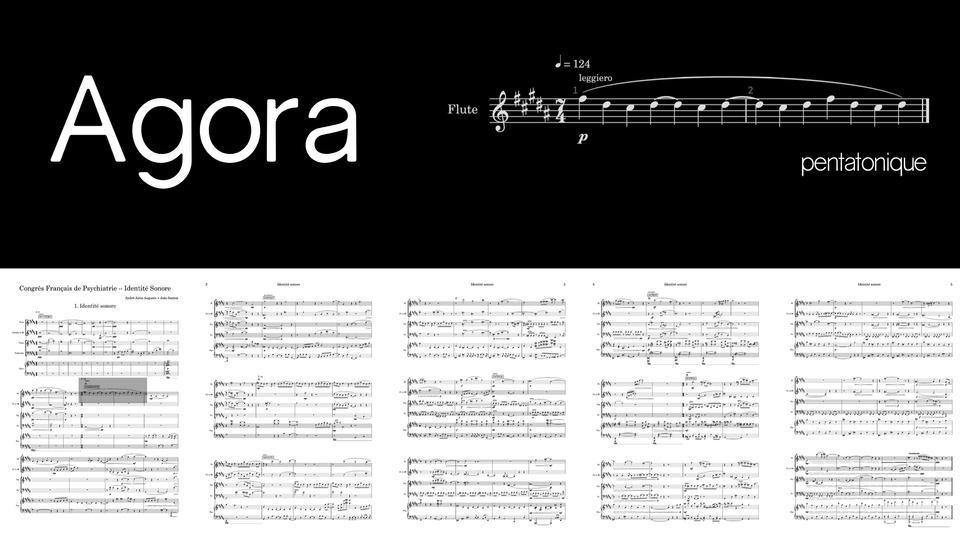
“This choice is both symbolic and fundamental. The pentatonic scale functions as a kind of universal language, found across many cultures: Africa, Asia, the Americas, Celtic Europe, and others. It is also present in children’s music, often sung intuitively using pentatonic patterns.
From a more musicological point of view, the absence of semitones creates space for each note, avoiding melodic friction. This gives the scale a sense of fluidity and openness, favourable to exchange and dialogue. The pentatonic scale can therefore be understood as a shared space of expression and mutual recognition, a kind of musical agora.”
Psyché
On parle de psychiatrie on parle de psyché.
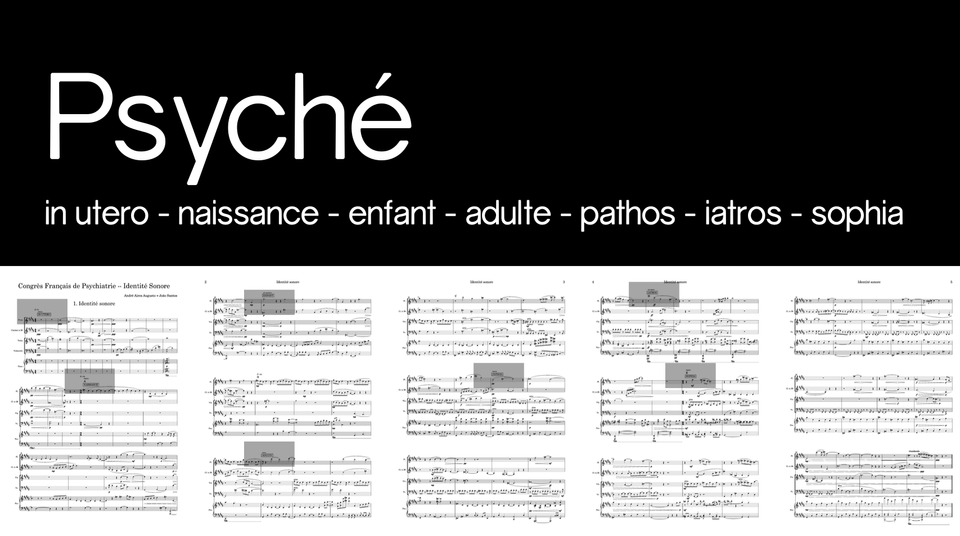
La composition illustre le développement d’une psyché, depuis son origine jusqu’à sa pleine maturité.
A travers la progression musicale, les timbres, les rythmes et les harmonies traduisent la formation, la croissance, la crise et la cure, comme des métaphores des étapes intérieures d’une psyché dans sa quête d’identité et de sens.
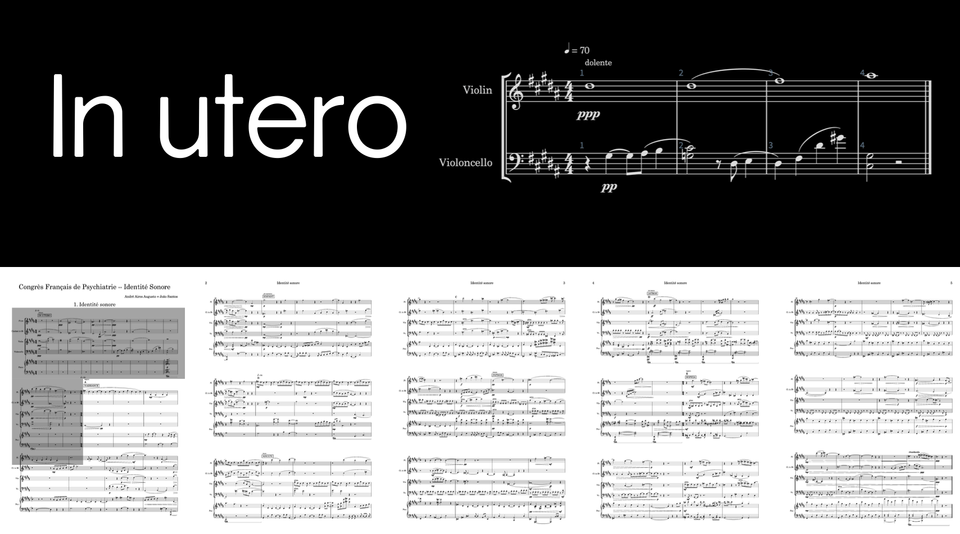
In utero
The violin, with its fragility, high register, and sometimes trembling timbre, perfectly conveys the vulnerability and lightness of a being in formation.
The cello, by contrast, brings a warm, enveloping presence. Placed in a lower register, it establishes a stable foundation and acts as a maternal ‘sonic cradle’. It represents a protective cocoon, the matrix that contains and nourishes the future being.
The dialogue between these two voices, the hesitant violin and the supporting cello, becomes a musical metaphor for the in utero moment: a relationship of sonic attachment.
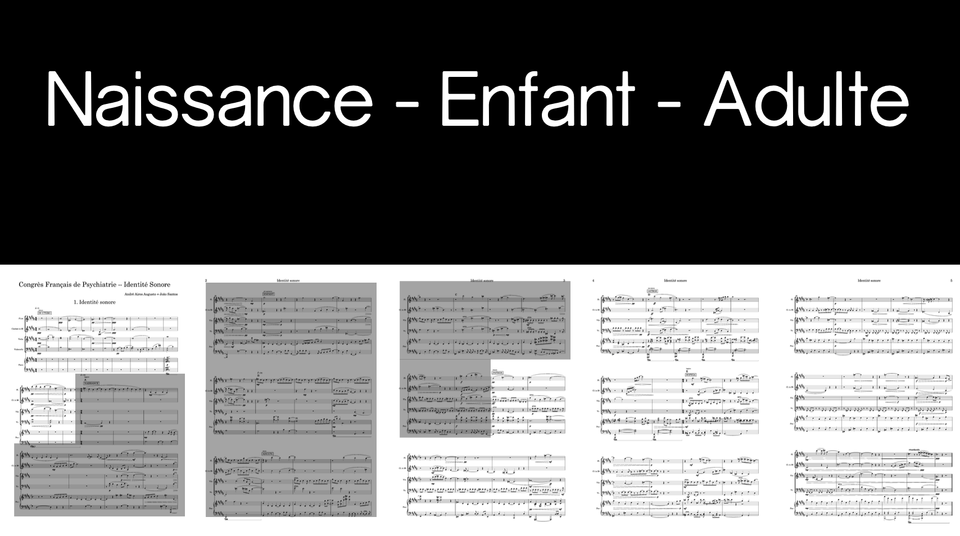
Naissance - Enfant - Adulte
This section is built on an asymmetrical or irregular rhythm, using a 7/4 metre, creating a subtle tension and a sense of fluctuation. This irregularity generates a rhythmic flow that reflects life’s unpredictability, the uncertain nature of growth, and the repeated surprises inherent in any process of development.
Across the different sections, there is a gradual increase in density and complexity, tracing a clear metaphor for development.
Naissance section the piece is anchored in the original simplicity of a pentatonic melody, the ‘genesis of the psyche’.
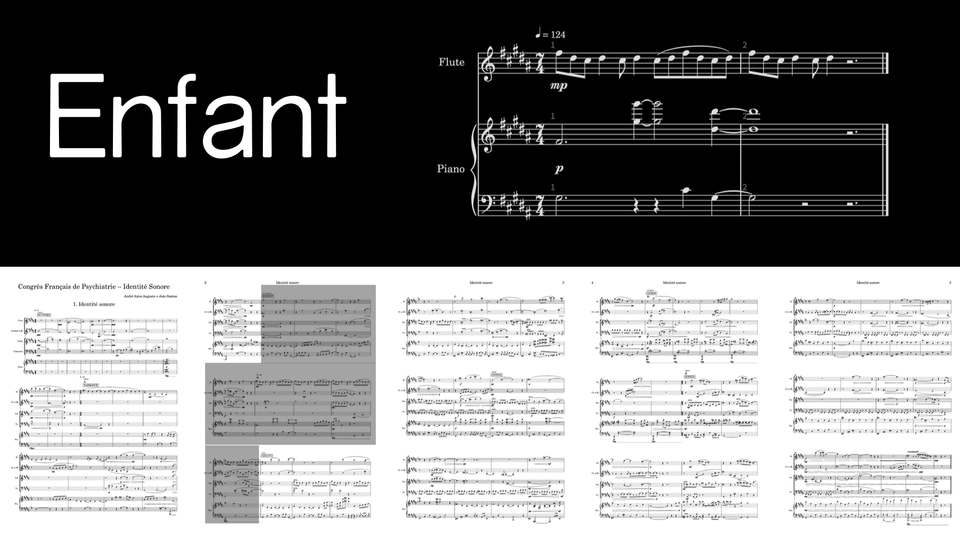
Enfant
Enfant: the musical discourse becomes more expressive and more rhythmic; the lines intersect more frequently, like early interactions.
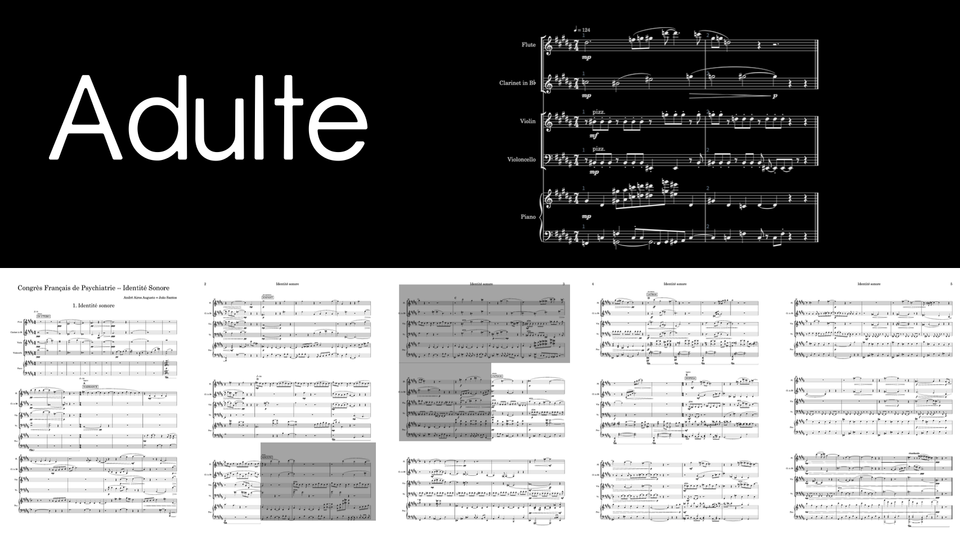
Adulte
Finally, "dult the writing becomes assertive, polyphonic, and decisive, with more pronounced staccatos. Each note gains its own individuality, as if the subject has become fully autonomous; these brief, repeated attacks convey determination.
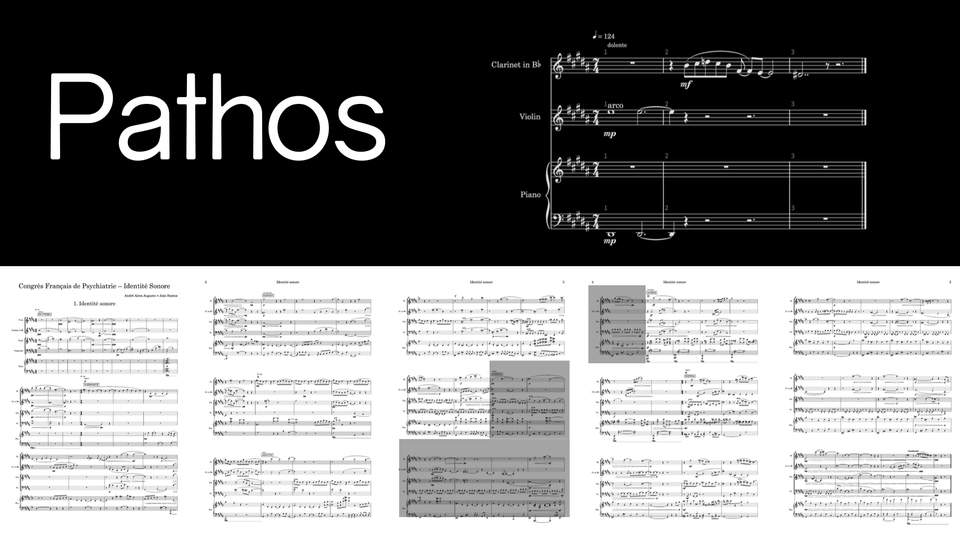
Pathos
Until this point, the music’s upward and luminous evolution suddenly shifts, and the tonality becomes darker and more tense.
The appearance of semitones, frequencies placed too close to one another, minor seconds, introduces inner tension.
These increasingly frequent dissonances convey a sense of fragility and vulnerability.
Descending melodic movements suggest an emotional collapse.
Iatros
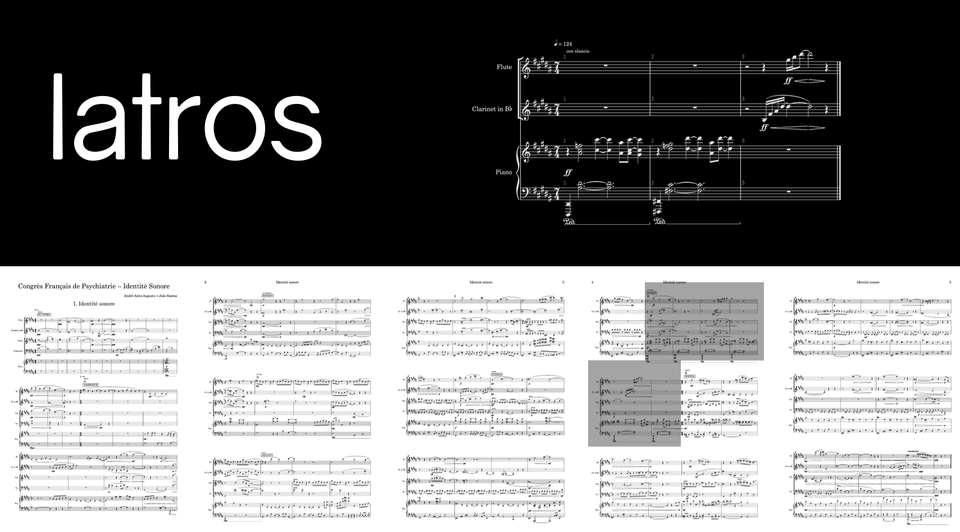
“Inner healing.”
A strong piano dynamic contrasts with the previous passages, marking an internal struggle.
A faster, more energetic rhythm, with accents, reinforces the sense of a vital, almost combative drive.
An ascending melody in the melodic instruments creates growing tension, a movement upward, or an assertion of self.
In the symbolic context of the Psyche, this passage can indeed be interpreted as the psyche’s internal struggle: a fight for balance or reconstruction after the “Pathos” crisis.
Sophia
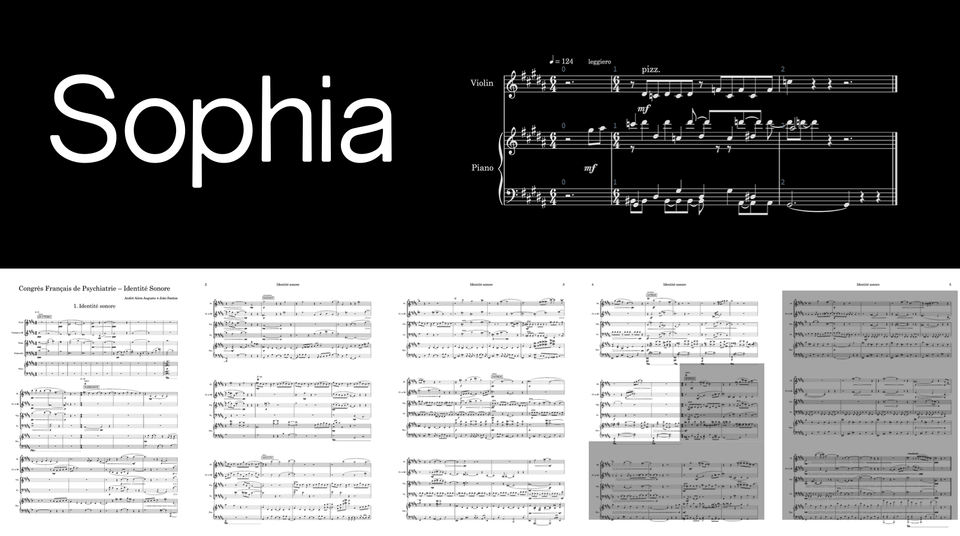
The “Sophia” section is the resolution and transcendence of everything that came before.
With a clear change in rhythmic structure (6/4 time), this section represents a psyche that can finally, with the calm that only a lifetime of experience brings, dance a long waltz.
Sophia embodies wisdom, the inner reconciliation after struggles.
The release of accumulated dissonances.
The alternation of pizzicato and arco serves as a metaphor for the connection of opposites.


CSupport:
ongrès Français de Psychiatrie, | Conservatoire de Musique et Théâtre de Cannes, | CARCO Team
